


Understanding High-Barrier Films For Food Packaging
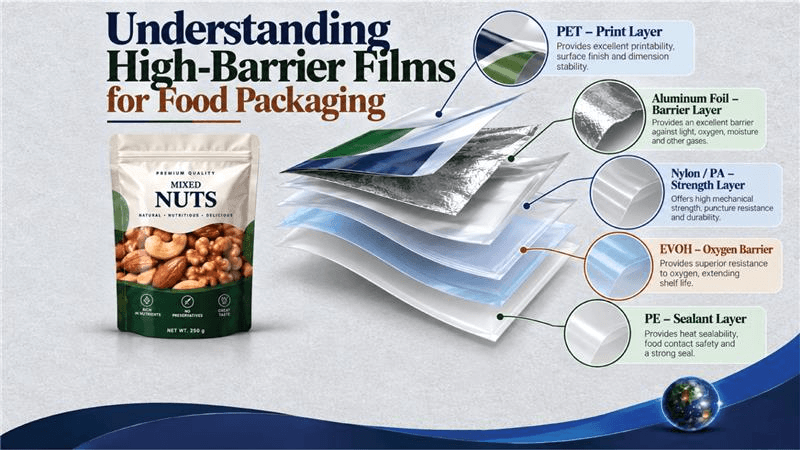
Understanding High-Barrier Films For Food Packaging
High-barrier films are flexible packaging materials used for food products where strong resistance to moisture, oxygen, light, aroma transfer, and external contaminants is required. These films are particularly relevant for foods with sensitive textures, flavours, fats, or nutritional components. The appropriate film structure is selected according to the food type, intended shelf life, filling process, sealing method, and storage conditions. Explore high-barrier films for food packaging, their materials, barrier properties, testing methods, and suitable applications in detail.
What Are High-Barrier Films?
High-barrier films are multilayer or specially engineered flexible film structures with low transmission rates for moisture, oxygen, and other external substances. Common materials include PET, PE, PP, metallized PET, aluminium foil, and EVOH. The final film construction is determined according to barrier requirements, mechanical strength, heat sealing, printing specifications, and packaging format.
Why Use High-Barrier Films For Food?
Moisture, oxygen, light, and aroma exposure may affect the quality of the product during storage. Moisture absorption may affect the texture of dry foods, while oxygen exposure may contribute to oxidation in foods containing fats. High-barrier films are therefore considered where longer shelf life and better preservation of the product are required. Important factors include water vapour transmission rate (WVTR), oxygen transmission rate (OTR), light protection, and seal integrity.
Moisture And Oxygen Barrier Films
A low WVTR indicates lower water vapour transmission through the film structure, which is important for foods sensitive to humidity. ASTM F1249 is used for water vapour transmission rate testing through plastic films and flexible barrier materials. A low OTR indicates lower oxygen transmission through the packaging film. ASTM D3985 is used for oxygen gas transmission rate testing through plastic film and sheeting. Required WVTR and OTR values are determined according to the food type, expected shelf life, storage environment, and complete packaging structure.
Types Of High-Barrier Packaging Films
Different films are selected according to moisture, oxygen, light, sealing, and mechanical requirements.
Aluminium Foil Barrier Films
Aluminium foil laminates are associated with strong protection against moisture, oxygen, and light. They are considered for freeze-dried meals, emergency foods, coffee, and other products requiring high barrier performance. The laminate structure is determined according to food-contact requirements, sealing method, shelf life, and storage conditions.
Metallized PET Barrier Films
Metallized PET is considered where moisture, oxygen, and light resistance are required within a flexible film structure. Barrier performance is influenced by metallization quality, film thickness, laminate construction, and sealing conditions.
PET And PE Barrier Films
PET is commonly included as an outer layer where strength, printability, and dimensional stability are required. PE is frequently included as an inner heat-sealing layer where flexibility and seal performance are important. The combination is selected according to barrier requirements, pouch format, printing, and sealing conditions.
EVOH Oxygen Barrier Films
EVOH is recognised for strong oxygen-barrier performance and is included within multilayer constructions where oxygen protection is required. Its barrier properties are influenced by humidity and the surrounding film structure.
PP Barrier Films
PP is used in food packaging structures where stiffness, moisture resistance, and heat resistance are required. Final performance is determined by the specific PP grade and complete film construction.
Kraft vs Mylar Packaging For Freeze-Dried Food
Kraft and Mylar packaging differ in material structure and barrier performance. Kraft paper is commonly included as an outer layer for a natural paper appearance, while Mylar, referring to polyester film such as PET, is considered for strength and barrier performance. For freeze-dried foods, Kraft-based laminates are considered for paper appearance, while metallized PET or foil-based structures are considered for stronger moisture, oxygen, and light protection. The suitable option is selected according to shelf life, storage conditions, sealing requirements, and protection of the product. Learn More
Multilayer High-Barrier Film Structures
Multilayer films contain two or more layers with different material properties. Each layer is selected according to requirements such as strength, sealing, moisture resistance, oxygen resistance, printability, and food-contact suitability.
A typical structure may contain an outer PET layer, a barrier layer such as metallized PET or EVOH, and an inner PE sealing layer. The final multilayer construction is determined according to the food product, filling process, sealing equipment, storage conditions, and intended shelf life.
High-Barrier Film Properties And Testing
Several specifications are considered when high-barrier films are selected for food packaging:
-
WVTR: Water vapour transmission through the film.
-
OTR: Oxygen transmission through the film.
-
Seal Strength: Strength of the sealed area under specified testing conditions.
-
Film Thickness: Related to mechanical and barrier properties.
-
Light Barrier: Level of protection against light exposure.
-
Aroma Barrier: Resistance to transmission or loss of volatile compounds.
ASTM F1249 is used for WVTR testing, ASTM D3985 for OTR testing, and ASTM F88/F88M for seal-strength testing. Test conditions are selected according to the film structure and intended packaging application.
High-Barrier Films For Food Packaging
High-barrier films are used across food categories where moisture, oxygen, light, or aroma protection is required.
Freeze-Dried Foods
Freeze-dried foods are highly sensitive to moisture absorption. Aluminium foil laminates, metallized PET structures, and suitable multilayer films are considered for freeze-dried fruits, vegetables, meals, snacks, and emergency foods.
Coffee Packaging
Coffee is sensitive to oxygen, moisture, light, and aroma loss. High-barrier laminates are therefore considered for roasted and ground coffee according to the coffee type, filling method, degassing requirements, closure system, and shelf-life target.
Snack Foods
Crisps, nuts, granola, and dried fruits may require moisture and oxygen protection. The film structure is selected according to texture, fat content, shelf-life target, storage environment, and sealing requirements.
Meat And Jerky
Meat and jerky packaging may require oxygen and moisture control depending on processing and shelf-life requirements. Suitable high-barrier structures and vacuum formats are considered where reduced oxygen exposure is required.
Powdered Foods
Powdered foods may be sensitive to humidity and oxygen. High-barrier films are therefore considered where protection against moisture absorption and oxidation is required.
High-Barrier Pouch Packaging Formats
High-barrier films are used in flexible formats including stand-up pouches, three-side seal pouches, flat pouches, gusseted pouches, resealable pouches, and vacuum-sealed formats. The suitable format is selected according to product quantity, filling method, closure requirements, storage conditions, and barrier performance.
Recyclable High-Barrier Food Packaging
Recyclable mono-material structures and recycled-content films are increasingly considered for flexible food packaging. Suitability depends on material composition, recycling infrastructure, food-contact requirements, expected shelf life, and the required level of moisture or oxygen protection.
Canadian Food Packaging Regulations
Food packaging sold in Canada is subject to applicable requirements under the Food and Drugs Act, Food and Drug Regulations, Safe Food for Canadians Regulations (SFCR), Consumer Packaging and Labelling Act, and Consumer Packaging and Labelling Regulations. For consumer prepackaged food, applicable labelling requirements include the common name, net quantity, and mandatory information in both English and French, subject to applicable exceptions. SFCR section 206 addresses bilingual labelling requirements for consumer prepackaged food. Food-contact packaging materials should be suitable for their intended conditions of use, including the food type, material, contact conditions, temperature, and duration.
“Customers will occasionally buy products not because they want them but because of how they are presented to them.” — James Clear
Conclusion
High-barrier films are an important part of flexible food packaging where protection against moisture, oxygen, light, and aroma transfer is required. Aluminium foil, metallized PET, PET, PE, PP, EVOH, and multilayer constructions are selected according to the food product and intended shelf life. Barrier performance is assessed through WVTR, OTR, seal strength, film thickness, and light protection. For food businesses seeking suitable packaging structures, Custom Packaging is offered with high-barrier film options according to product sensitivity, filling requirements, storage conditions, and packaging specifications.
Universal Packaging Adds New Die-Cutting Machine in Mississauga
Universal Packaging is adding the Webcontrol KDC-600 die-cutting machine at its Mississauga facility, supporting die-cut custom bags and flexible packaging formats. The addition reflects continued investment in production technology, with die-cutting capabilities supported through equipment designed for shaped pouch production and post-bag-making die cutting. The Webcontrol KDC-600 features a maximum die-cut width of 300 mm, die-cut length of 700 mm, and speed of up to 120 pieces per minute.
"Our continued expansion across Canada brings us closer to customers, with advanced printing technology supporting flexible packaging solutions and ongoing growth," said Daniel James, Managing Director of Universal Packaging. This same approach is being carried out for the die-cutting machines. Supporting this development, William Crooks, Designer at Universal Packaging, added, "The upgraded digital printing process is designed for greater consistency in presentation across formats." The same approach is also being carried out through the die-cutting technique. Supporting Mississauga’s broader business environment, Mississauga Mayor Carolyn Parrish said, “Mississauga is Ontario’s second-largest economy and home to more than 100,000 businesses employing more than 500,000 people.”
Universal Packaging plans to extend the same die-cutting capability to its Toronto branch as part of its continued Canadian production development.
Frequently Asked Questions
What Are High-Barrier Films Used For?
High-barrier films are used for food products where protection against moisture, oxygen, light, or aroma transfer is required. They are particularly considered for products requiring extended shelf life and preservation of the quality of the product.
What Materials Are Used In High-Barrier Films?
Common materials include PET, PE, PP, aluminium foil, metallized PET, and EVOH. These materials are combined according to barrier requirements, sealing properties, strength, printing specifications, and food-contact considerations.
What Is WVTR In Food Packaging Films?
WVTR refers to water vapour transmission rate through a packaging film. Lower WVTR values are generally associated with stronger moisture-barrier performance for foods sensitive to humidity.
Are High-Barrier Films Suitable For Freeze-Dried Foods?
High-barrier films are commonly considered for freeze-dried foods because moisture absorption may affect texture and quality. Aluminium foil laminates, metallized PET structures, and suitable multilayer films are selected according to the required barrier performance.
Are Recyclable High-Barrier Films Suitable For Food Packaging?
Recyclable mono-material and other recyclable structures are being developed for flexible food packaging. Suitability depends on barrier requirements, material composition, recycling infrastructure, food-contact requirements, and intended shelf life.
 Turkish
 English
 Arabic
 French
 Spanish
 Portuguese
 Deutsch
 Dutch
Dutch
 Italiano
 Russian
 Romaian
 Portuguese (Brazil)
 Greek
Greek
