


How Conversion Funnel Optimization Can Improve Customer Acquisition
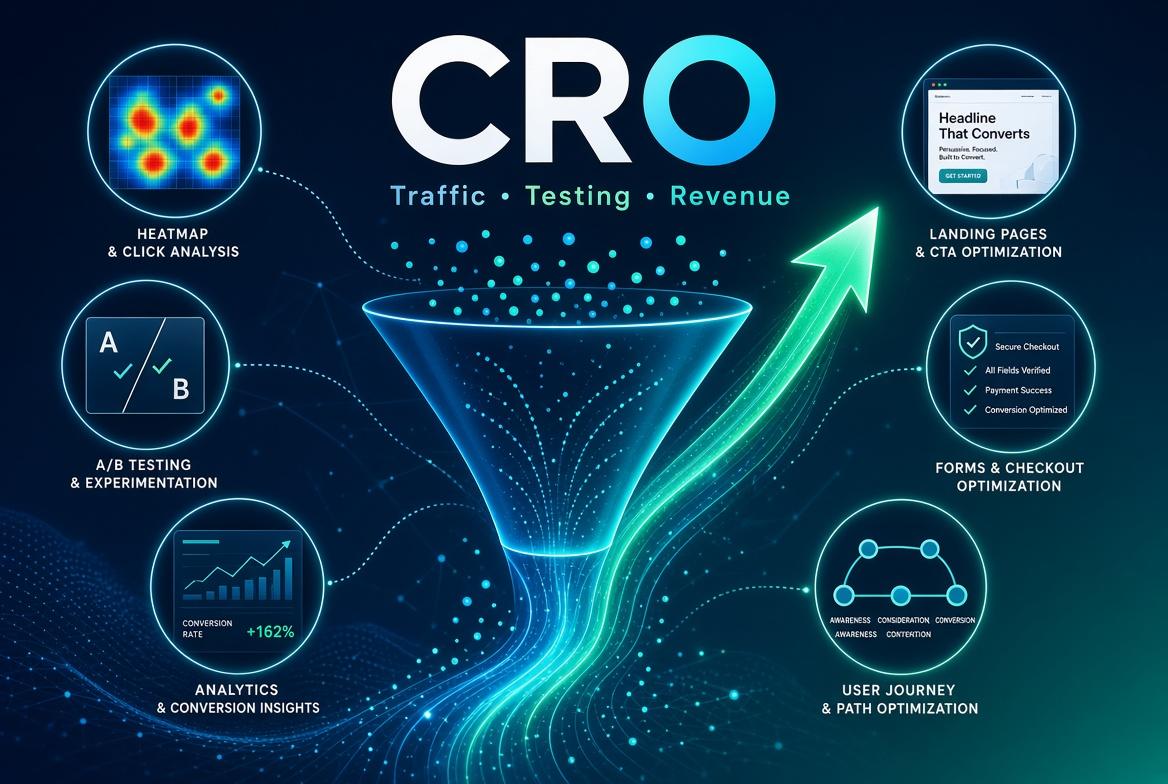
Getting visitors to a website is only the beginning of the customer acquisition process. A business may invest heavily in SEO, advertising, social media, and content marketing, yet still struggle to turn website visitors into leads or customers. When this happens, the problem may not be a lack of traffic. It may be what happens after visitors arrive.
This is where conversion rate optimization services can provide significant value. Conversion funnel optimization examines the complete journey a potential customer takes, from the first interaction with a website to completing an important action such as submitting a form, booking a consultation, signing up for a service, or making a purchase.
Instead of simply trying to attract more visitors, businesses can focus on helping existing visitors move through the customer journey more effectively. This can improve marketing efficiency and create more opportunities without requiring a proportional increase in advertising or traffic.
Understanding the Conversion Funnel
Every Visitor Has a Different Level of Intent
A conversion funnel represents the different stages a visitor may pass through before becoming a customer. Someone discovering a company for the first time may only be researching a problem, while another visitor may already be comparing providers and looking for pricing or a consultation.
Treating both visitors in exactly the same way can create unnecessary friction. Effective funnel optimization considers where users are in their decision making process and provides relevant information at each stage.
For example, a SaaS company might use educational content to attract early stage visitors, comparison pages for users evaluating alternatives, and product demonstrations for prospects closer to making a decision.
Google Analytics provides funnel reporting that can help businesses visualize user journeys, completion rates, and abandonment at different stages.
Where Businesses Commonly Lose Potential Customers
The Landing Page Does Not Match the Visitor's Intent
A visitor clicking an advertisement or search result expects the destination page to address the reason they clicked. If the page contains vague messaging, unrelated information, or an unclear next step, the visitor may leave.
This is why landing page optimization services can be an important part of a broader conversion strategy. The headline, supporting copy, visuals, trust signals, forms, and calls to action should work together to answer the visitor's questions and make the next action obvious.
Consider a company advertising a free consultation. If the advertisement promises a specific business solution but the landing page simply presents a generic homepage, the visitor may not immediately understand what to do next. A focused landing page can create a much more direct connection between the original message and the desired conversion.
Forms and Checkout Processes Create Too Much Friction
Even interested visitors can abandon a website when completing a form feels unnecessarily difficult. Long forms, confusing fields, unclear instructions, or concerns about privacy can reduce completion rates.
Businesses should review every field and ask whether it is genuinely necessary at that stage of the customer journey. A company may be able to request additional information later rather than requiring everything before the initial conversation.
The same principle applies to ecommerce checkout processes and service booking systems. The fewer unnecessary obstacles a user encounters, the easier it becomes to complete the intended action.
How Conversion Rate Optimization Services Improve the Journey
Start With Data Instead of Assumptions
Effective CRO should begin with evidence. Businesses need to understand where users enter the website, which pages they visit, where they abandon the funnel, and which actions indicate stronger buying intent.
Analytics can help reveal these patterns. Google Analytics funnel reporting, for example, can show step completion and abandonment rates, making it easier to identify stages where users are dropping out.
Suppose an online service business receives substantial traffic to its pricing page but very few consultation requests. Rather than immediately increasing advertising spend, the company could investigate whether pricing information is unclear, the call to action is difficult to find, or visitors have unanswered objections.
Test Changes Systematically
Once a potential problem has been identified, businesses can test improvements rather than relying entirely on personal opinions.
An experiment might compare two headlines, different calls to action, alternative form layouts, or variations of a landing page. The purpose is to determine which version produces a better outcome for the defined audience.
Testing should be connected to a specific objective. A higher click rate is useful only if those additional clicks eventually contribute to meaningful conversions. Google Analytics supports conversion reporting and attribution analysis that can help businesses evaluate how marketing touchpoints contribute to conversion events.
Improving Website Conversion Optimization
Website conversion optimization involves more than changing button colors or rearranging page elements. It requires understanding what customers need before they are willing to take action.
Strong pages generally communicate a clear value proposition, demonstrate credibility, answer important questions, and provide an obvious next step. Testimonials, reviews, case studies, guarantees, security information, transparent pricing, and relevant product details can all help reduce uncertainty when appropriate.
Mobile experience is equally important. A page that works well on a desktop but has difficult navigation or poorly displayed forms on smaller screens can create unnecessary barriers for a significant portion of visitors.
A Practical Example of Funnel Optimization
Imagine a digital marketing company receiving 10,000 monthly website visitors but only 100 consultation requests. Increasing traffic might seem like the obvious solution, but the existing funnel may already contain valuable opportunities.
A CRO analysis could discover that visitors are engaging with service pages but rarely reaching the consultation form. The business could then improve internal navigation, clarify service benefits, add relevant proof, simplify the form, and test stronger calls to action.
If those changes increase the percentage of visitors who become inquiries, the company can generate more leads from the traffic it already has. This is one of the main reasons CRO can complement SEO and paid marketing rather than compete with them.
Building a Continuous Optimization Process
Conversion optimization should not be treated as a one time website redesign. Customer expectations, competitors, traffic sources, offers, and business objectives can change over time. Businesses should instead treat optimization as an ongoing process of testing, learning, and improving the user experience. Google also supports the use of third party A/B testing integrations with Google Analytics 4 for experimentation. Google Analytics guidance on A/B testing integrations
A better approach is to establish a continuous process. Businesses can review analytics, identify friction points, prioritize opportunities, test changes, measure results, and use the findings to inform the next experiment. This creates a cycle of improvement rather than relying on a single major redesign every few years.
Conclusion
Customer acquisition becomes more efficient when businesses understand not only how to attract visitors but also how to guide those visitors toward meaningful actions. Conversion rate optimization services help companies analyze customer journeys, identify friction, improve landing pages, test new approaches, and make better use of existing website traffic.
The strongest results usually come from combining data with customer understanding. By improving the conversion funnel step by step, businesses can create a smoother experience while increasing the potential value of their existing marketing efforts.
If your business wants to improve website performance and create more effective digital experiences, explore Crecentech's custom technology solutions to support your broader digital growth strategy.
Frequently Asked Questions
What are conversion rate optimization services?
Conversion rate optimization services help businesses increase the percentage of website visitors who complete valuable actions such as submitting forms, making purchases, booking appointments, or requesting information.
How does conversion funnel optimization improve customer acquisition?
It identifies points where potential customers leave the buying journey and improves those stages through better messaging, landing pages, navigation, forms, calls to action, and user experiences.
Why are landing pages important for conversion optimization?
Landing pages provide a focused experience for visitors arriving from search engines, advertisements, email campaigns, or other channels. A relevant and well structured page can make the desired action easier to understand and complete.
What is the difference between SEO and conversion rate optimization?
SEO focuses primarily on improving visibility and attracting relevant organic visitors, while CRO focuses on helping more of those visitors complete valuable actions after reaching the website. The two strategies work well together.
How can businesses identify where visitors abandon a conversion funnel?
Analytics tools can track user journeys and funnel steps to reveal where visitors stop progressing. Businesses can then investigate those stages and test improvements based on the available data.
How long does conversion rate optimization take to produce results?
The timeline varies according to website traffic, audience size, funnel complexity, testing methodology, and the changes being evaluated. Some improvements can produce early insights, while sustainable optimization requires ongoing testing.
Can conversion rate optimization reduce customer acquisition costs?
It can. If a business converts a greater percentage of existing visitors into leads or customers, it may generate more results from the same marketing investment, potentially improving overall acquisition efficiency.
Should a business invest in CRO if its website already receives significant traffic?
Yes. High traffic does not automatically mean strong conversion performance. CRO can help businesses understand whether existing visitors are encountering barriers and identify opportunities to generate more value from current traffic.
 Turkish
 English
 Arabic
 French
 Spanish
 Portuguese
 Deutsch
 Dutch
Dutch
 Italiano
 Russian
 Romaian
 Portuguese (Brazil)
 Greek
Greek
